
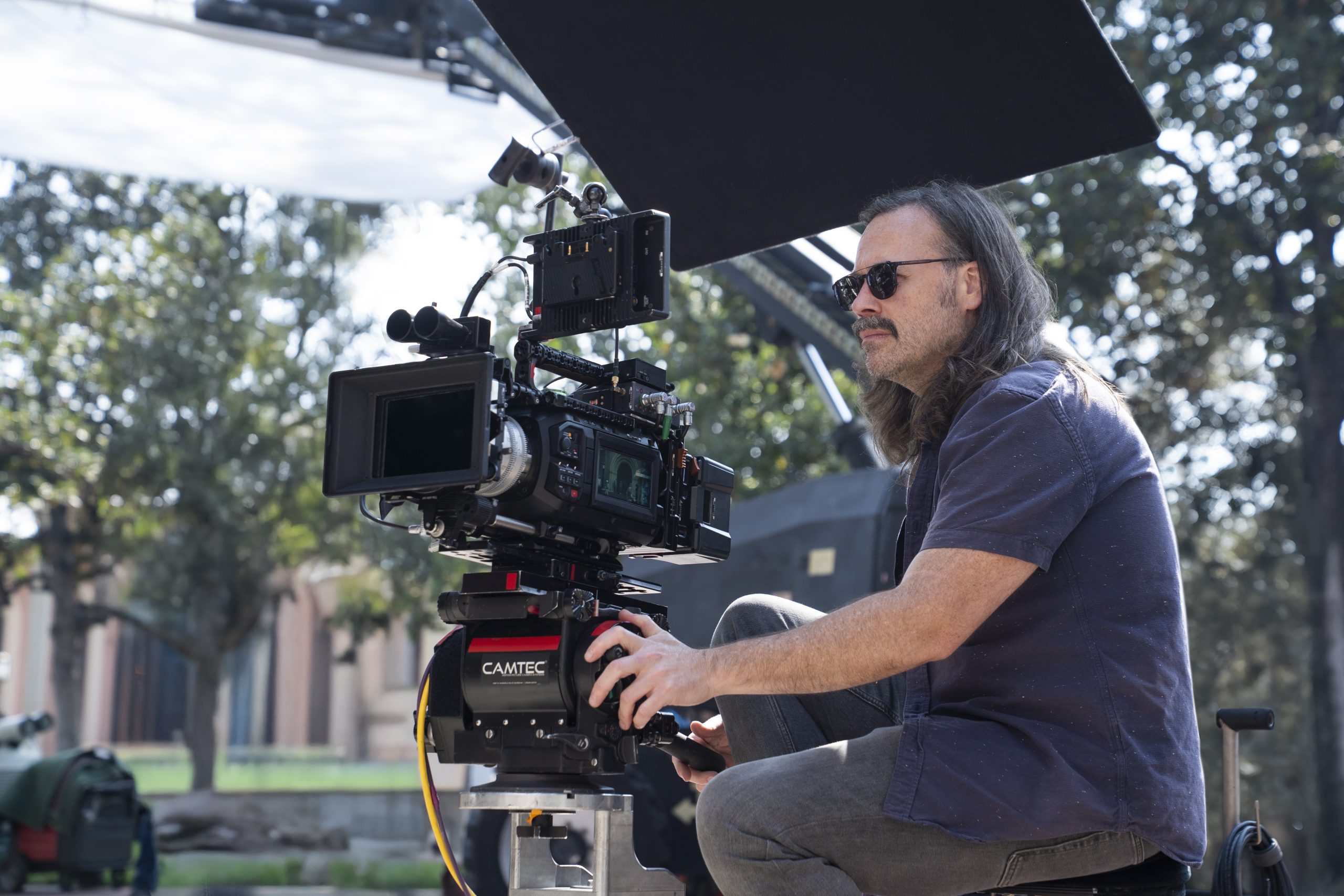
Bill Lawrence gave Blake McClure, ASC one instruction. What he built from it is one of the more interesting-looking comedies on television right now.
Bill Lawrence’s creative note to his new cinematographer, delivered at the start of production on Rooster, was four words: see the actors’ faces.
“The only thing Bill told me, Bill and Matt told me, is: just make sure we see the actors’ faces,” says Blake McClure, ASC in an interview with People of Post. “That’s literally all they said.”
That is either the simplest brief a DP has ever received or an open invitation to figure everything else out himself. McClure took it as the latter. What he built from that single note — the camera choice, the lighting logic, the scheduling, the depth of field argument — adds up to one of the better-looking comedies on television right now.
Rooster, which premiered on HBO in March and was renewed for a second season before its first run even finished, is set at Ludlow College, a fictional liberal arts school in New England. Steve Carell plays Greg Russo, a pulp thriller author who inserts himself into his daughter’s (Charly Clive) professional and personal life after her marriage starts to unravel. The campus is beautiful, the light is rich and contrasty, and it doesn’t look like anything else in the comedy space right now.
The Look
McClure came onto Rooster through line producer David Hyman and Unit Production Manager Daniel Portnoy, the latter someone he had just worked with on another project. Working with pilot director Jonathan Krisel, he built a visual pitch around a small handful of films. The earliest and most-referenced was Dream Scenario — simple lighting, real contrast, windows blown out, shadows that actually go dark. The first reference Lawrence brought to the table himself was The Holdovers, Alexander Payne’s digitally shot but film-treated New England campus drama. Dead Poets Society was in the mix too.
The through line across all of them was a camera that felt like it had been somewhere, rather than one optimized to record everything cleanly. That distinction matters to McClure in a way that edges toward a grievance. “The blacks were richer, the highlights were blown out — it wasn’t so much information in between,” he says of the film-to-digital transition of the 2000s. “We have so much latitude now, and a lot of shows have a lack of personality because of that.”
He shot Rooster on the Blackmagic URSA Cine 17K 65, a large-format 65mm digital camera that, as Film and Digital Times reported in March, was not yet commercially shipping when production began. He had come across it while shooting All’s Fair at Warner Bros., where John Brawley, ACS, was on the same lot with the smaller URSA Cine 12K on Shrinking. McClure’s DIT flagged the newer version as worth a test. What drew him to the 65mm format had nothing to do with going wide — he was thinking about how a larger sensor relates to a face, how it compresses and isolates. It also solved a problem he had already spotted.
The interior sets at Warner Bros. had been built before he was hired, the outer walls fixed. Some ended up with very little distance between the windows and the backing drops, leaving almost no room for lighting rigs outside. For McClure that was useful rather than limiting — a larger sensor’s natural falloff would let those drops go soft behind actors who were already closer to the lens than any standard comedy setup would put them. “The actor’s closer to the camera,” he says. “Let that stuff fall off.”
Per Film and Digital Times, the production ran four cameras on prototype units, shooting in a 2:1 aspect ratio at 8K rather than the full 17K, a compromise worked out with Blackmagic two weeks before photography began. Post ran through Digital Film Tree, the same house that handled Shrinking. McClure brought his colorist, Josh Bohoskey of boutique house Rare Medium — a collaboration going back nearly a decade across SNL, A.P. Bio, and Miracle Workers — and they built the LUT together over multiple rounds of tests.
The Ceiling Rule
On every show he does, the first conversation McClure has with the production designer is about ceilings. He wants them. He was having one thirty minutes before we spoke, on a current prep.
A set with a ceiling forces commitment. The lights have to come from somewhere that makes physical sense. The practicals have to do real work. “I want to be restricted,” he says. “I want to be able to shoot the way I have to shoot a location. I want to eliminate a thousand possibilities — it just makes it feel more real.” A stage with open overhead space and infinite rigging options produces images he finds too clean, too easy. “You go to set and you have all this control, but then you hate it because you had too much control.”
The show is set in New England fall and winter but shot late April through early August 2025 in Los Angeles. On a show built around natural-feeling light, that gap was real. The solution was scheduling of a kind McClure hadn’t had access to in years — the AD team broke scenes across the day, holding the second half for better light, moving around the building on location at the University of the Pacific in Stockton. For the entire first season, exactly one scene had to be shot in the middle of the day.
The Portrait
All of it comes back to the same idea. The show should feel like a portrait. The actors’ faces are the subject. Everything else should know its place.
“I feel like viewers are tired of shallow depth of field, honestly,” he says — not the deliberate kind, but the reflexive kind, soft backgrounds that have become a default rather than a decision. “But I wanted this to feel like a portrait and really focus attention on the actor.”
None of it holds without the right crew. A-camera operator Neal Bryant — “the best steadicam operator I’ve ever worked with, and the loveliest human being” — and B-camera operator and second DP Michelle Gonzalez gave him the room to step away and prep upcoming scenes while the set kept moving. Gaffer Christian Grosselfinger has been his collaborator for fifteen years. “He knows what I’m thinking,” McClure says. “I can do what I do because of the people I work with. By far.”
For context, the Ryan Murphy productions — five collaborations now, from Ratched through All’s Fair — operate at a very different frequency. Seemingly fully designed worlds, a clear visual identity already waiting in the room. The DP’s job is not to walk in and screw up what has already been fully imagined. Bill Lawrence runs a different kind of set. “They really allowed all of us to do what we do,” McClure says. “Everybody on set is having a lot more fun. It’s not work. The cast is fantastic. It felt very collaborative and you don’t get that too often.”
He calls Rooster his favorite show he has ever done. Which, given the resume, is saying something.
Rooster airs Sundays on HBO and is streaming on Max. It was renewed for a second season in April 2026.


