
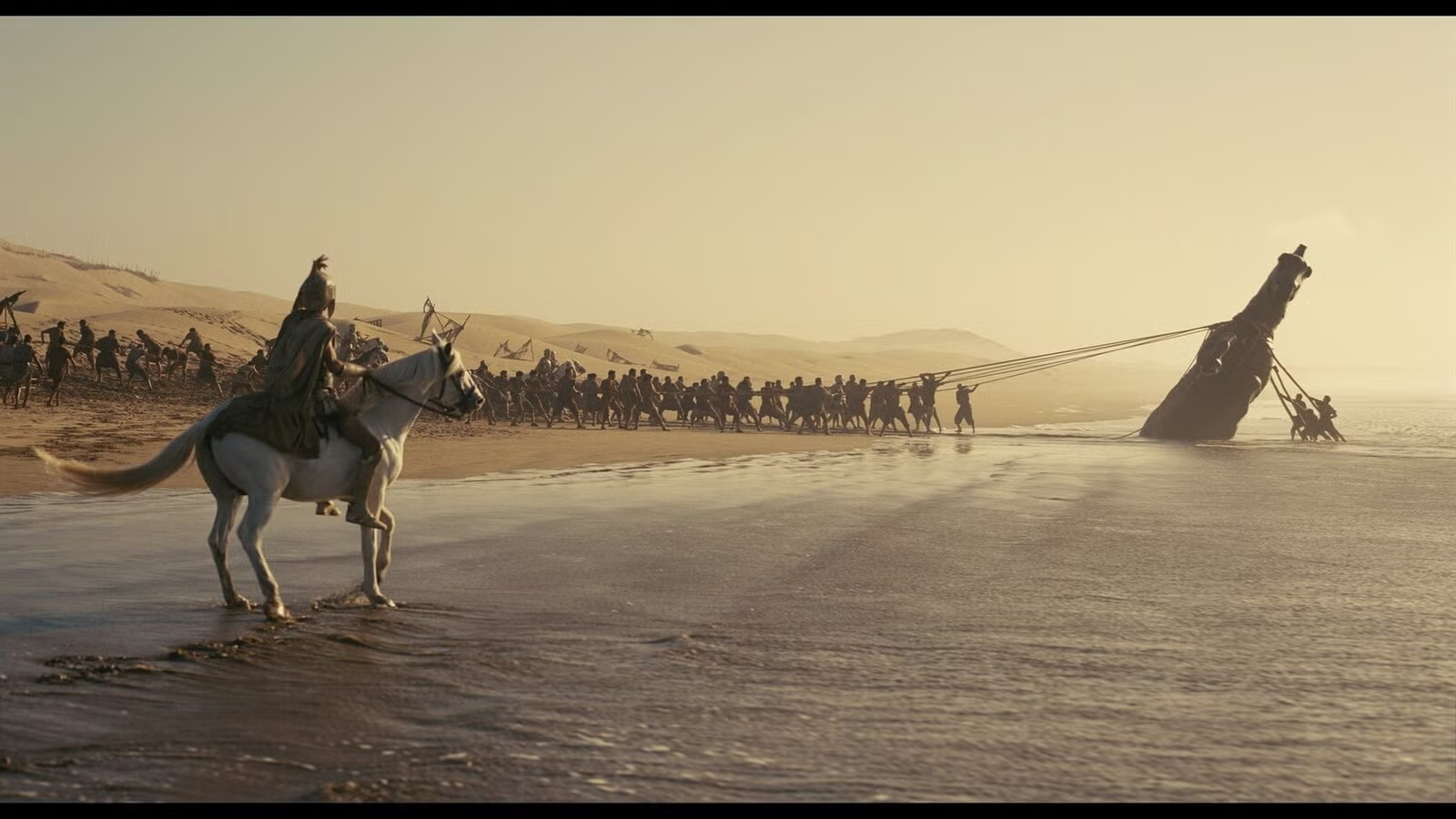
Before Christopher Nolan committed to shooting The Odyssey entirely on IMAX, cinematographer Hoyte van Hoytema needed proof the format could do something it had never really been asked to do: hold a quiet conversation. His test was disarmingly simple. He filmed a child in extreme close-up on IMAX film, reading the lyrics to David Bowie’s “Sound and Vision” off a piece of paper, and projected the footage for Nolan. It became the proof of concept for the first narrative feature ever shot entirely on IMAX cameras. It also set off a chain reaction that ran straight through post.
This isn’t a small swing. The Odyssey carries a reported $250 million budget, was shot across six countries in 91 days, and opened to the kind of numbers that make it the biggest live-action release of the summer. It’s also the fifth film van Hoytema has shot for Nolan, following Interstellar, Dunkirk, Tenet, and Oppenheimer, the last of which won him the cinematography Oscar. Nobody understands Nolan’s visual instincts better at this point, and nobody was better positioned to know exactly how far this particular bet could be pushed.
IMAX cameras were never built for this kind of filmmaking. They’re loud, they’re heavy, and until this production, they were largely incompatible with the black-and-white 65mm stock Nolan wanted for the film. Getting there meant going back to Kodak from scratch. “The light would bleed back into the films,” van Hoytema explained to Variety, describing how the metal pressure plates behind the film gates were never designed for backing that thin. Solving it meant re-engineering the cameras themselves, then building lighter bodies the crew could physically carry into the locations the film demanded, from Moroccan ruins to Icelandic coastline, and eventually to a 300-pound rig hauled up a Sicilian clifftop by helicopter.
For Nolan, that difficulty was never really the point, it was the cost of admission. He’s spoken for years about wanting to put audiences physically inside a story rather than showing it to them from a comfortable distance, and The Odyssey pushes that instinct further than anything he’s made before. Speaking to the New York Times, he described the appeal of shooting real actors in a real ocean rather than building the moment from scratch, saying it creates “a photographic authenticity that visual effects can then build upon.” That’s a director explaining, in plain terms, why he’d rather solve a hundred physical problems than fake one shot.
When Nolan unveiled footage at CinemaCon this spring, he got a standing ovation before he’d said a word, and he used the moment to trace the format back to his own childhood. “As a boy, all I wanted to do was tell large-scale stories using that technology, putting the audience into the world,” he told the crowd, tracing the ambition back through The Dark Knight and describing this as the first time his crew had managed to shoot an entire film that way. Van Hoytema was standing beside him.
But the same camera that made those images possible created a problem for the department that inherits its footage: sound.
Nolan’s dialogue mixing has been a flashpoint for years, and it isn’t new to this film. Complaints about muffled or “inaudible” dialogue followed Tenet and then Oppenheimer, and Nolan has never treated the criticism as an accident to be quietly fixed. In Tom Shone’s book The Nolan Variations, he pushed back directly on the idea that volume was ever the real issue, describing the criticism as being about “the whole enchilada” of how a film gets mixed, not a simple levels problem. He’s also been candid about resisting ADR, the standard process of rerecording dialogue in a booth after the fact, in favor of whatever imperfect, textured audio was actually captured on set. For years, his workaround was largely a post-production one: software built to filter camera noise out of production audio after the fact, a fix he’s described as improving steadily over the fifteen-plus years he’s been shooting on IMAX.
The Odyssey tried to solve the problem at the source instead. IMAX built a new camera housing, known internally as a “blimp,” specifically to cut down the mechanical noise the cameras produce during a take. Nolan called the results a genuine breakthrough for performance, telling Empire that the new system meant a crew could be “shooting a foot from an actor’s face while they’re whispering and get usable sound.” It’s a small, technical-sounding claim that describes something enormous: the difference between an actor performing for the camera and an actor performing in spite of it.
That shift landed squarely on the team responsible for making The Odyssey work in theaters: re-recording mixers Gary A. Rizzo and Kevin O’Connell, alongside production sound mixers Willie D. Burton and Craig Henighan. This isn’t a group meeting Nolan’s philosophy for the first time. The same three names, Burton, Rizzo, and O’Connell, took home the Cinema Audio Society Award for Oppenheimer, meaning the trio tasked with taming The Odyssey’s audio had already solved a version of this exact problem together once before, on a film with the same director and many of the same constraints. Rizzo alone has three prior Nolan credits, including an Oscar for Dunkirk‘s sound mixing. O’Connell, for his part, spent two decades as the answer to a rough piece of Oscar trivia, holding the record for most Academy Award nominations without a win until Hacksaw Ridge finally broke the streak in 2017.
Their job on The Odyssey was to take audio that was, for the first time, actually recordable that close to an actor’s face, and shape it into a full theatrical mix without sanding off the rawness Nolan refuses to give up. It’s unglamorous, largely invisible work, and it only succeeds when nobody notices it happened at all. Judging by the film’s reception so far, packed IMAX houses and very little of the dialogue-audibility backlash that dogged Oppenheimer, it’s work that held.
Van Hoytema’s early test with the Bowie lyrics was never really about whether IMAX could resolve a child’s face in close-up. It was a bet that the format could carry sound and image together without one undermining the other, a bet that shifted the burden from the camera department onto the mixing stage the moment production wrapped. Whether it paid off was ultimately a question for the mix, not the lens. But watching The Odyssey in IMAX this summer, it’s worth remembering that the clarity of what you’re hearing was being solved for years before a single frame was shot.


