
Brian Philip Davis knew Hokum before the cameras rolled. When he and director Damian McCarthy were still in the cutting room on Oddity, McCarthy was already writing, arriving each morning with new ideas from the night before. “He’s a complete workaholic,” Davis says in an interview with People of Post. “He’s always writing more scripts.” By the time McCarthy sent the finished screenplay, Davis had been absorbing the film’s DNA for months.
That kind of lead time shapes a collaboration. The two men have now made two films together, and the shorthand runs deep. “If we have a problem, we can refer back to previous similar problems, solutions that we had for those problems,” Davis says. “He has a trust in me because we have a very similar sense of humor, sort of similar taste in movies.” What that trust looks like in practice: McCarthy shoots while Davis cuts, largely without him. By the time the director walks into the editing room, there’s already a film waiting.
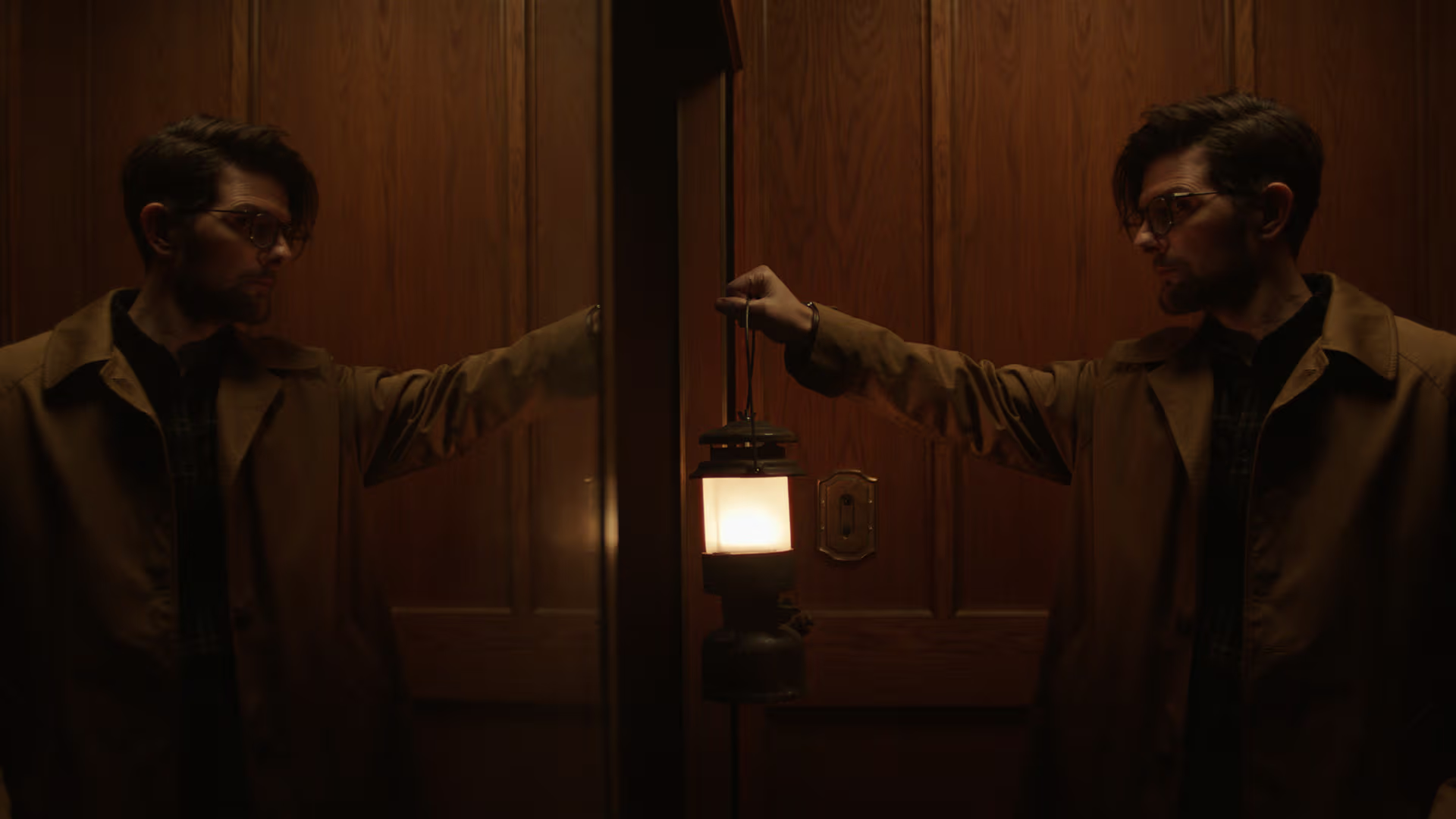
Hokum, released by Neon on May 1, follows Ohm Bauman — a horror novelist played by Adam Scott — who retreats to a remote Irish inn to scatter his parents’ ashes and finds himself drawn into local tales of a witch haunting the honeymoon suite. It is a contained film, mostly one man in a building, and that containment is felt in the editing. “If there are multiple people in a scene, you could always cut away to a reaction if you get into trouble,” Davis says. “With the honeymoon suite and Adam, we just had to be…” He pauses. “The sequences were so well designed by Damien that we had everything we needed.”
The constraint is its own kind of pressure. And the pressure Davis talks about most is one that doesn’t show up on screen.
“The actual scare is actually quite easy,” he says. “You just cut something quickly. It’s a surprise. But a lot of times in these movies, the audience knows something is coming. So it’s about the journey and how you get there.” The editor’s job, in his telling, is to stay out of the material’s way long enough to let the tension build. The trap is familiarity. “There’s a temptation, the longer you’ve been working on something, to keep cutting it and cutting it and making it tighter and tighter. But you always have to remember what that experience is going to be for the first-time viewer.” A shot of Adam Scott walking across a hotel room, in the context of a horror film, carries weight. Davis’s job is to protect it.
In a 2024 interview about Oddity, Davis put it plainly: “Editing is not just about knowing when to cut. It’s about knowing when not to cut.”
The dumbwaiter sequence is the film’s most discussed scene and, by Davis’s account, its most instructive one. In it, Ohm spots the witch at the end of a dark corridor beneath the hotel, escapes up the dumbwaiter, pokes his head back into the shaft to check the coast is clear, and then sees the witch crawling up the walls toward him. Ahead of the film’s release, Davis told SlashFilm what his reaction was on first reading the script: “I thought, ‘God, this is an action movie. This is not just a horror movie, this is an action movie.’ The character that Adam plays is literally being chased around a room by a witch.”
Action coverage, by its nature, is limited. You shoot what you need and not much more, which means the assembly tends to come together relatively cleanly. The sequence wasn’t radically restructured. The experimentation happened in the details. Running through the scene is a cherub statue, decorative and mischievous, and Davis and McCarthy spent time working out how often to return to it. How many close-ups were too many. And then, late in the process, they added one more. After Ohm dives out of the dumbwaiter and lands on the floor, having narrowly avoided being sent back down, one extra shot of the cherub’s face. “That always gets a massive laugh at the screenings I’ve been in,” Davis says. “You have to have that open-mindedness to experiment, even late. Just always experiment with other options that may make it scarier or funnier or more entertaining.”
That openness runs through his test screening methodology, which he describes as essential for both horror and comedy. The audible reaction from an audience tells you things the cutting room can’t. McCarthy shared an early cut with his girlfriend and the result identified a problem: the film’s first scare, involving a character named Albie and the witch in an elevator, cut directly to Scott lifting his glass and saying “hokum.” McCarthy’s girlfriend was still reacting to the scare when the line played. She missed the joke. “Yeah, we need to open that up,” Davis says. “Give it more of a gap, just to let that scare land.”
The tonal balance between scare and laugh is something Davis thinks about structurally. In an interview with Film Ireland, he described the principle directly: “Horror and humour are closely linked. They both rely on timing and surprise.” His instinct in the cutting room is to look for moments that already exist in the material rather than manufacturing them. “If it makes him laugh or makes me laugh, it must be going to make somebody else laugh out there,” he says of working with McCarthy. “We have that trust that if it works for us, it must work for other people.”
Hokum is mostly a linear story, and the structural overhauls that defined the Oddity edit weren’t necessary here. But one problem did surface in testing. The film opens with a scene involving a conquistador and a boy, establishing the world of the novel Ohm is writing, before cutting to the title card and then Ohm himself, explaining the story at a bar. Audiences found the connection confusing. McCarthy shot a new scene: Ohm at his laptop, typing. It clarified the relationship between the story-within-the-story and the main narrative, enabled a match cut, and allowed for an earlier scare in the film’s opening minutes. A problem the edit found, solved by going back to the set.
Davis’s next film is The Incomer, a folk comedy directed by Louis Paxton and starring Domhnall Gleeson, which won the Sundance NEXT Innovator Award and is due from Focus Features later this year. The genre shift changes some things. “With comedy, you usually have to go a little bit tighter, just keep it snappier,” he says. “It’s not so much about the atmosphere and the tension.” But the core problem lands in the same place: you lose your sense of what’s funny in the same way you lose your sense of what’s scary. Three months into an edit, a joke that made you laugh in the rushes has become invisible. “Test screenings are absolutely critical.”
Hokum was cut with the assistance of Adrian Conway and Stephen Kidney. “They really worked their ass off to make everything happen,” Davis says.


