
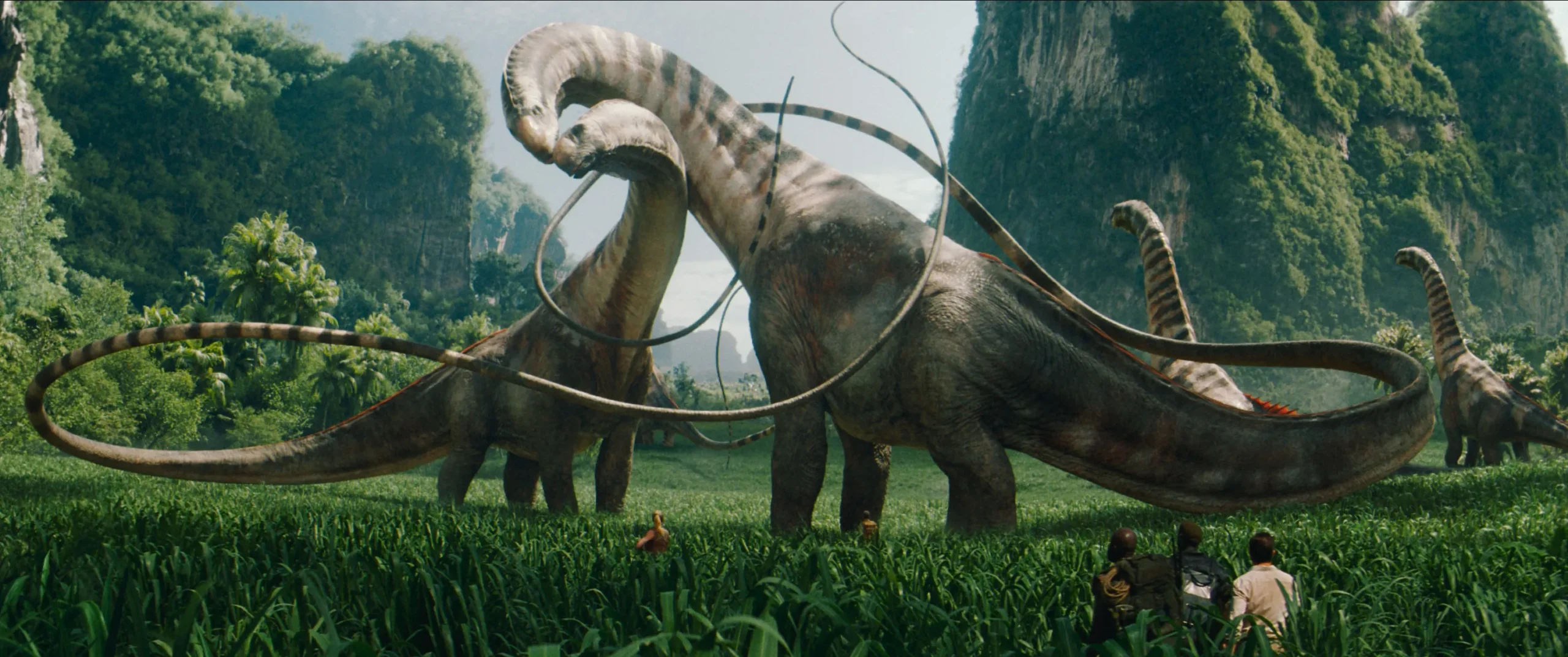
Jurassic World: Rebirth asks audiences to believe in thunder that breathes. A fresh cast and a reset premise help, but the illusion lives or dies in the visual effects. Production VFX Supervisor David Vickery, leading ILM and a platoon of partner vendors, steers the film toward tactile spectacle: creatures that feel heavy, wet, wind-battered, and photographed rather than painted. The result is a franchise entry that plays cleaner than recent sequels and, in premium formats, delivers the old-school awe the brand promises.
Building a Real-World Pipeline
Rebirth’s VFX footprint is predictably vast, yet Vickery’s method is grounded. ILM leads the work, with Important Looking Pirates among the featured vendors, an arrangement in line with Vickery’s previous Jurassic tours and one the studio has publicly framed around “photo-real creatures and environments.”
Philosophically, he keeps the compass simple starting from a place of real-world reference, Vickery said to DigitalTrends while discussing his Jurassic process during the prior film’s rollout, a stance that maps neatly onto Rebirth’s more naturalistic tone.
Director Gareth Edwards, a VFX native himself, pushes in the same direction. “This movie is kind of what I’ve been waiting for… it’s mine to screw up,” he told The Guardian, framing Rebirth as a back-to-basics exercise where photographic plausibility beats CG bravado. That outlook matches the film’s blend of practical elements, on-location plates, and dense creature simulation.
The pipeline reflects that pragmatism. Vickery, as the project’s Production VFX Supervisor, coordinated cross-studio asset builds and stage-to-post data so animation, lighting, and compositing live on sturdy plate photography. It is industrial, yes, but also refreshingly conservative about what the camera must capture for the pixels to sing.
The Raft, the Rex, and the Rule of Physics
Marketing leans into a sequence long rumored among Crichton die-hards: a white-knuckle river run with a T-Rex gaining in the spray. It is an elegant stress test for the movie’s visual language. The water throws scale problems at every frame. Spray has to diffract correctly around paddles. Skin needs sub-surface scatter without looking waxy. Weight must read when the Rex lunges into current. Rebirth clears those hurdles, and in theaters the scene lands as clean geography plus adrenalized chaos rather than a CG salad.
You can feel the creative restraint: editorial keeps intercuts legible, camera placements stay near-human, and animation choices privilege animal intent over “cool move” choreography. None of that happens by accident. It comes from a production brief where Vickery’s team references real animal kinetics and water behavior first, then layers hero beats on top. That has been his north star in the franchise, and it reads on screen here as clarity under pressure.
Why Vickery’s Approach Works
Vickery’s résumé is a primer on large-scale believability. At ILM he supervised Jurassic World: Dominion and, before that, led creature and environment work across tentpoles that demanded practical-plus-digital thinking. The continuity matters: the job on a Jurassic film is less inventing a new look than coaxing a classic to feel observed again.
He also collaborates like a filmmaker, not a post fixer. Rebirth arrives under Edwards, whose creature features favor documentary-adjacent framing and light sources that fight back. That pushes VFX toward defensible physics. When a flare throws red spill across scales, the comp should inherit photographic messiness rather than chase sterile perfection. Edwards’ own comments about blending artistry and commercial spectacle hint at that ethos, and Vickery’s track record suggests he is the right partner to keep the illusion honest.
There is a practical side effect. Effects that start in reality tend to grade more gracefully. Rebirth’s home-entertainment specs and premium theatrical runs underline Dolby Vision and Atmos presentations, which reward contrast-rich plates and textured mids. While color and sound belong to other departments, VFX either supports or sabotages them. Here, the departments interlock
Rebirth plays like a course correction powered by craft. The story is leaner, the creature beats clearer, and the showpiece moments resist overcutting. Vickery’s department is a big reason why. The dinosaurs look photographed, not rendered; the composites sit in the plate without pleading for attention; and the film’s set pieces earn their scale because they obey the rules laid down in preproduction. When the T-Rex stomps into the river light and the audience leans forward as one, it is not nostalgia doing the work. It is pipeline discipline, animal study, and a supervisor who knows that the fastest way to a wonder shot is to start with physics and keep the camera honest.
Editor’s Note: This profile was compiled using publicly available interviews and press materials. All quotes are attributed to their original sources. No new interviews were conducted for this piece.


