
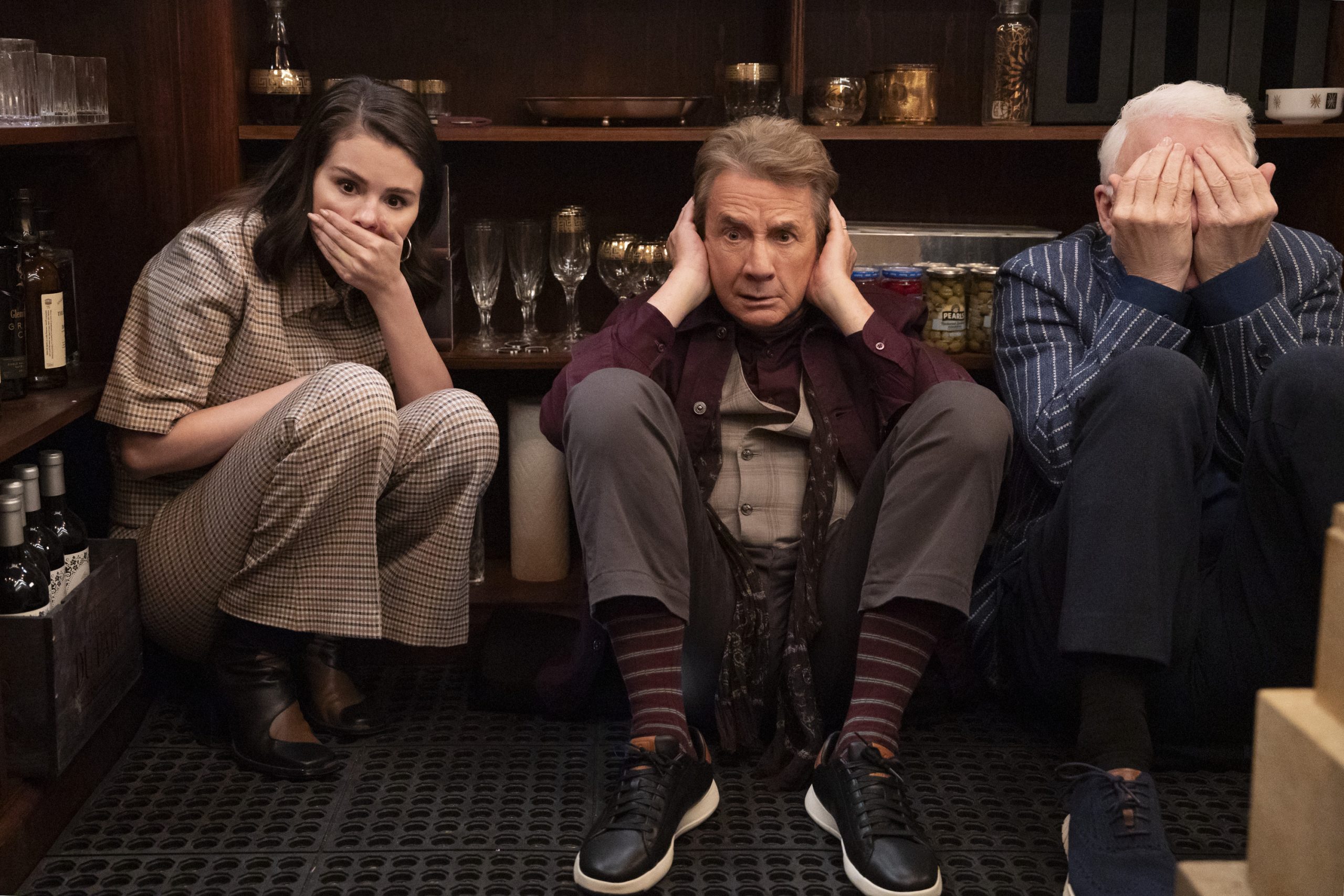
The Arconia has always been more than a backdrop. It creaks, it hums, it listens. On Only Murders in the Building, the sound of the place is as vital as the script or the cast. For Season 5, the team keeping those walls alive consists of production sound mixer Joseph White Jr., CAS, supervising sound editors Matthew Waters, CAS and Danika Benton Wikke, MPSE, and re-recording mixers Kyle O’Neal, CAS and Waters. Their work ensures that every muffled confession, every nervous laugh, and every ominous silence hits with intention.
Building a Darker Arconia
Season 5 shifts the show into more personal, more ominous territory. The central mystery — Lester’s death — pulls the comedy deeper into grief and betrayal. The sound follows suit. Silence isn’t just absence, it’s dread. Whispered dialogue echoes against the walls, and footsteps land heavier than before. The mix allows space for moments that earlier seasons might have undercut with levity. As supervising sound editor Matthew Waters put it in an earlier interview, the Arconia is given “its own sonic personality.” That idea feels even sharper now, with the building less a comic foil and more an accomplice.
White Jr. captures the raw material on set, wrangling a cast that now includes guest stars like Renée Zellweger and Christoph Waltz. Their distinct vocal tones demand careful placement in the soundscape so the central trio’s rhythms remain intact. Wikke polishes those lines, her dialogue editing ensuring that Selena Gomez’s understatements and Martin Short’s crescendos don’t cancel each other out. Then O’Neal and Waters shape the final mix, balancing Foley, score, and performance until the Arconia feels lived in and haunted at the same time.
When Silence Speaks
The series has long been praised for its use of restraint, most famously in the season one episode “The Boy from 6B,” told largely from a deaf character’s perspective. Critics are already comparing parts of Season 5 to that benchmark. Episodes lean into quiet, trusting the audience to lean closer rather than be pushed back by noise. A creaking stairwell, the soft scrape of a chair, or the pause before a line can now carry as much narrative weight as a shouted confrontation.
The team’s ability to subtract is as important as their ability to layer. It’s not about filling the soundtrack but about choosing when the absence of sound becomes the most powerful cue. That philosophy keeps the show tonally agile, able to pivot from comedy to suspense without breaking stride.
Waters’ experience on epic projects like Game of Thrones prepared him for creating environments that feel simultaneously intimate and vast. Wikke, whose credits span both drama and comedy, has built a reputation for making dialogue precise without stripping away personality. White Jr. brings decades of production experience, capturing performances so clean that post-production can focus on storytelling rather than repair. And O’Neal, working alongside Waters on the re-recording stage, brings a mixer’s discipline to comedy pacing and dramatic restraint alike.
Together, they form a unit built for tonal balance. Comedy timing survives in the crisp delivery of a muttered aside. Suspense lingers in the echo of a hallway. The craft is invisible, which is exactly why it works.
Only Murders in the Building could coast on its stars and clever mysteries. Instead, it sounds like nothing else on television. In Season 5, the Arconia speaks more clearly than ever. Every whisper, every echo, every silence is a narrative choice.
White Jr., Waters, Wikke, and O’Neal aren’t just supporting the story. They’re writing it in sound. And as this season proves, the Arconia remains one of TV’s most compelling characters — not just because of what we see, but because of what we hear.
Editor’s Note: This profile was compiled using publicly available interviews and press materials. All quotes are attributed to their original sources. No new interviews were conducted for this piece.


