
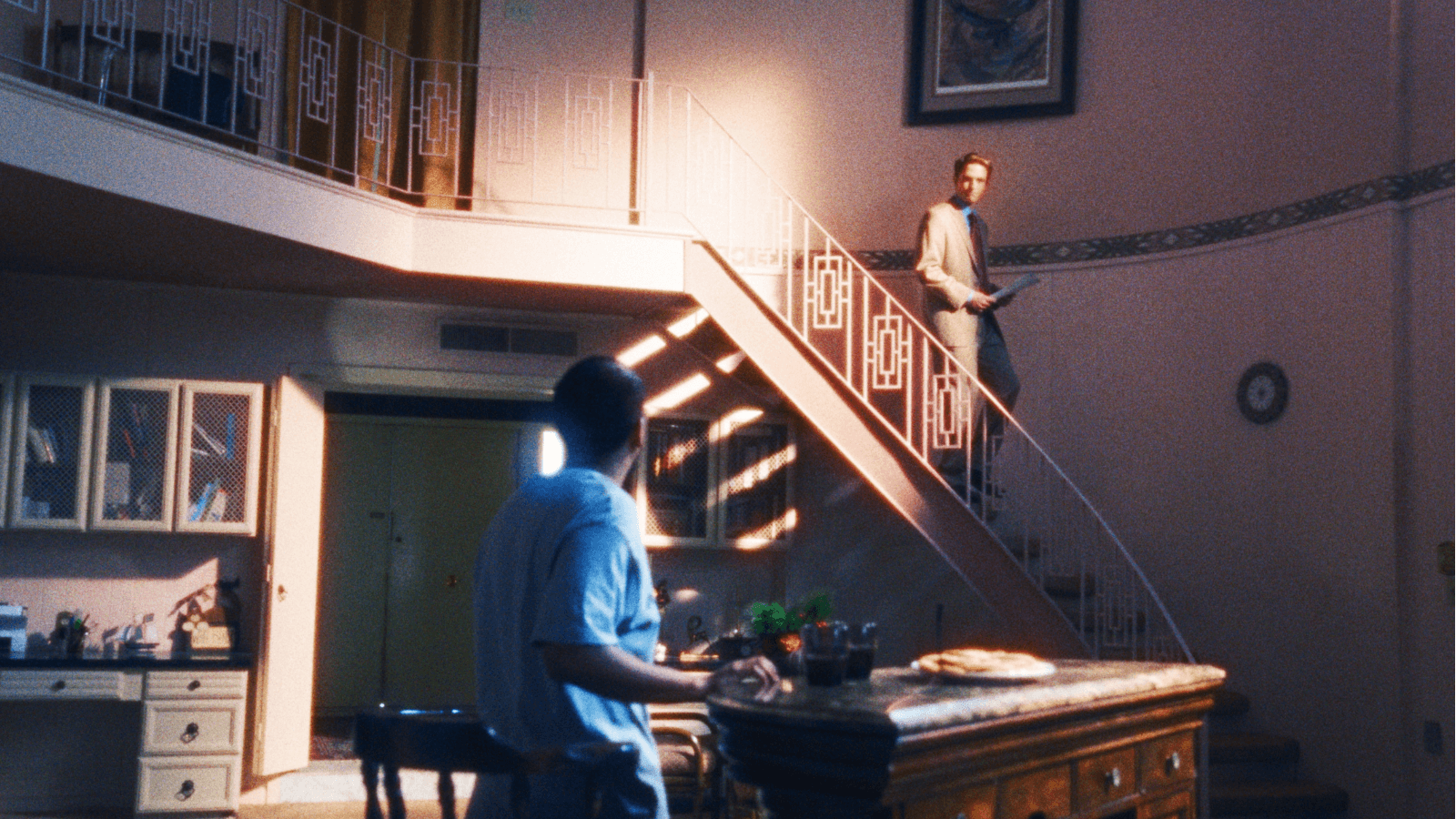
The first footage Chris Welcker saw from Primetime didn’t look right, and that was the point.
Before the shoot, director Lance Oppenheim and cinematographer David Bolen showed him camera tests of Robert Pattinson in character as To Catch a Predator host Chris Hansen. They had shot the tests on broken cameras, where “the image kind of had this overlaid look to itself where the different colors didn’t quite align with one another,” Welcker recalls, and then processed the results in ways that degraded them further.
“When I started seeing some of that footage, it gave me some ideas that, okay, I might be able to try to be more experimental than a typical film,” he says.
That’s an unusual invitation for a production sound mixer. Welcker is the New Orleans mixer who won an Emmy for Daisy Jones & The Six and earned an Oscar nomination earlier this year for Ryan Coogler’s Sinners, and most of his working days go to chasing the cleanest possible dialogue. On Primetime, A24’s drama about the making of NBC’s sting franchise, he was often recording two things at once: a polished feature film and the voyeuristic television show inside it. Some days, getting it right meant making it sound worse.
The experimenting started before cameras rolled. Welcker went looking for microphones that record frequencies above the range of human hearing and landed on a few Sennheiser models. The thinking was that “maybe post-production could pitch those things down and start to bring some interest to some of the sound design.”
It was his first time working with Oppenheim, the documentary filmmaker behind Some Kind of Heaven and Spermworld, who was making his first fiction feature and brought along what Welcker calls a core crew that he uses for his documentaries. When the production came to New Orleans in early 2025, a friend of Welcker’s who was one of the line producers reached out and sent him the script.
“And I said, of course. It was a crazy script,” he says. Meeting Oppenheim and Bolen, who clearly had years of history together, settled it. “Seeing some of his past projects, I thought it was like a no-brainer.”
New Orleans is home turf. Welcker grew up there, graduated from the University of Louisiana at Lafayette in 2004 and moved back as the state’s film tax incentive started drawing productions in. According to a 2024 profile in The New Orleans Advocate, his grandmother had been mailing him newspaper clippings about the incentive. His first film job came when a local comedy needed a DJ on short notice. He showed up with his turntable, met a boom operator and a sound mixer, and found his way into the sound department.
Two decades later, he’s best known for music-driven films, which makes Primetime an outlier. “It’s not a very musical movie,” he says. What it called for came from a less glamorous corner of his resume.
Wiring the Sting House
Early in his career, Welcker worked on hidden-camera shows, and he’s frank about how they sound.
“It doesn’t really sound great a lot of times on hidden camera shows, because you can’t put microphones on the people that you’re recording, because otherwise they would know they were on a show,” he says.
Instead, crews hide microphones around a location and try to steer people into the zones those mics cover. The result is a wider, roomier sound, “which is not really the best for film sound,” Welcker says. But it was exactly what Primetime needed. Oppenheim and Bolen planned to shoot the stings with what Welcker describes as “multi-camera approaches where we would have the whole set laid out with different cameras and hidden camera positions,” then shift to a conventional narrative style for other scenes. Welcker saw the jumps between those two textures as something the sound could follow.
“To have that shift in the perspective between film sound and hidden camera kind of lends itself to a lot of sonic interest,” he says, “the way that they would be shifting it with the edit.”
So he mapped the sting house the way the show’s own crew would have. “Imagine a grid, and you’ve got all these different camera angles that are showing up on one screen,” he says. There was the entrance where each suspect walks in, the chair Hansen eventually steers him toward and the area outside where “the SWAT team is ready to pounce on them when they leave the location.” Each zone got a looser-sounding plant mic. The chair, where the confrontations happen, got a closer one.
“We can hide a microphone right in that spot so that you can get more fidelity in terms of what they’re saying, but still have that loose, authentic hidden camera show feel to it,” he says.
When a scene shifted into hidden-camera mode, the crew stripped things back. “We would literally just take the microphones off the actors,” Welcker says. For those setups, the DPA lavaliers he has relied on for years gave way to Sanken COS-11s or Sennheiser mics, gear “more accustomed to a lower budget hidden camera show.” Post got fewer clean lavalier tracks and more plant mics scattered around the room.
“When you’re listening to it, you almost have to lean in a little bit closer to hear that dialogue delivered,” he says.
The workflow underneath never changed. Everything ran through his Sound Devices 8-Series recorder in the same track layout, so the post team’s files looked the same from scene to scene. “It’s really more about the microphone choices and how we go about capturing those performances in each moment,” he says.
The trickiest scenes put both styles in one room. Oppenheim keeps cutting to the show’s producers watching the stings unfold on a bank of monitors, and their reactions had to play like a movie while the footage they’re watching plays like TV. Welcker piped the hidden-camera audio through a speaker on set so the actors could hear it, then recorded their reactions the conventional way. “It really helps to blend those two things together,” he says.
Following the Voice
Pattinson’s Hansen voice has been one of the most talked-about parts of the film since its Venice premiere, where the actor told reporters he “found his accent very difficult,” according to the Associated Press. Welcker hands the credit straight back.
“Honestly, I think that a lot of that was more about just him and his performance,” he says.
His team’s job was to keep up. Pattinson would drop his volume on one take and project on the next, and the crew balanced boom and lavaliers depending on the shot. “You can get a lot more proximity and closeness with the lavalier mics sometimes when you’re doing wider shots than you can with a boom microphone,” Welcker explains.
One scene pulled them in closer. On a rooftop, Hansen plays catch with Decoy Dan, the aspiring actor played by Skyler Gisondo.
“It felt very intimate, and he was mentoring this young boy and ultimately kind of manipulating him to do what he wanted,” Welcker says. “In that moment, it felt like his voice was really deeper and very intense. And so we leaned very heavily on getting the mics as close as possible.”
Gisondo also brought the film its one real music problem. Dan sings twice, once on his audition tape and once in a car with the film’s final target, and Gisondo performed both live on set. With no backing track, his pitch had to hold steady from take to take.
“There were times where we would leave just a little beat before he would start singing so that we could actually play a tone in his ear, so that he could hear what pitch he should be aiming for from the very initial note,” Welcker says.
Out in the Grass
For the finale, the hidden mics went outdoors. Oppenheim stages the closing sequence in wide shots that punch into extreme close-ups, with so many angles covered that “we couldn’t get our boom operator out on the set in those moments,” Welcker says. The team hid microphones around the actors, “like in the grass,” and blended them with lavaliers so the sequence kept a cinematic feel “without sounding too reality TV or hidden camera in those moments.”
Shooting that loosely depends on the people around him. “When you have things that are being shot in kind of an improvisational sort of way, you really need to have a shorthand with your crew in order to be able to adapt and to respond to those things quickly enough,” he says. That shorthand belongs to boom operator Ryan Farris and utility sound technician Emily Poulliard, who have been with him for years. “Without them I couldn’t do any of this.”
Asked what made the film sound the way it does, he starts with “the people behind the lens and behind the microphones.”
Hearing It Back
Oppenheim made sure the handoff to post started early, putting Welcker in touch with Paul Hsu, the film’s re-recording mixer and sound designer. “Lance made sure that we were in contact with one another,” Welcker says. Because Oppenheim was on set and knew “what some of the ideas were as they were happening,” those ideas carried through to the final mix.
Still, there was a long gap between wrap and the first time Welcker saw the finished film. In the meantime, Sinners opened, awards season came and went, and his crew moved on to The Comeback King, Judd Apatow’s country music comedy starring Glen Powell, and now a Snoop Dogg biopic.
“You never really know how it’s gonna end up in the end,” he says. “You have these ideas of what you hope will be done with the material that you’re capturing.”
When he finally saw it, the plan had held. “I was happy to see that we were in sync in terms of how the post sound team handled things,” he says.
He first noticed it early, in Dan’s introduction. The scene opens tight on a pixelated image of Dan introducing himself on an audition tape, then slowly pulls back to reveal the little handicam recording him. On set, Welcker had captured the close section with nothing but a bare lavalier while the camera stared into that pixelated lens.
“As they pulled back and revealed that camera, it slowly started to have more of a film sound and more fidelity, just like the visuals were,” he says. “I thought that was just such a good transition between these different file formats in one continuous shot.”


